JOURNAL · IN THE MASTER'S WORDS
Taku Higano: A Life Given to the Brush
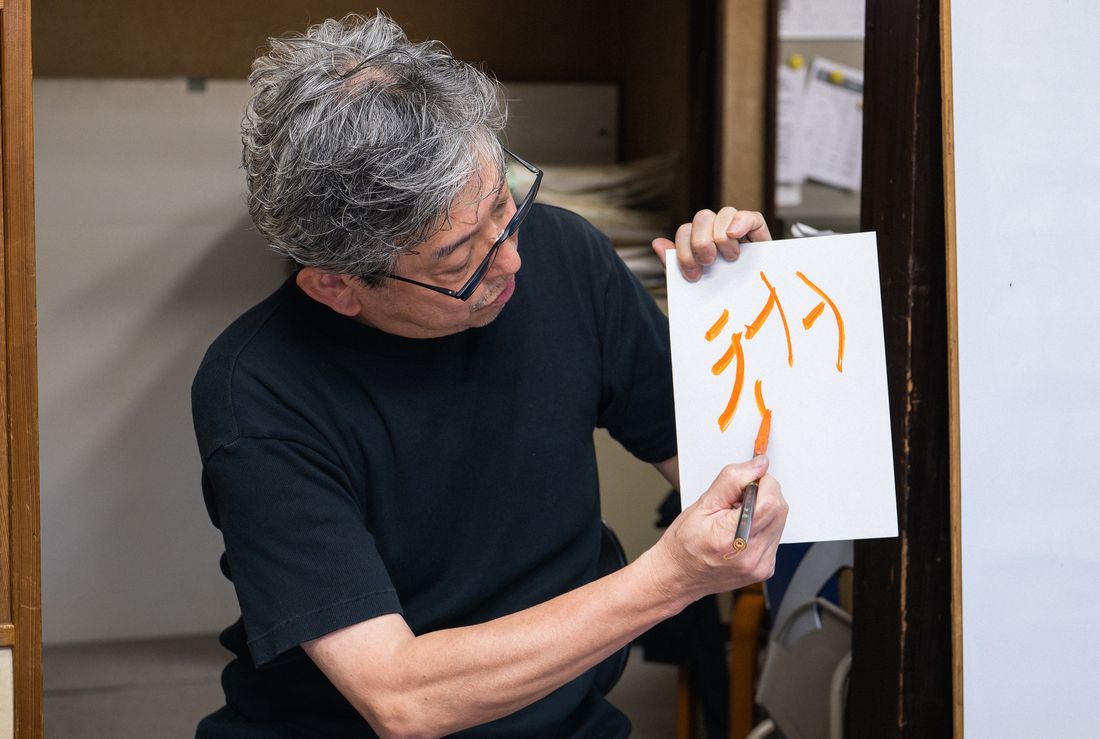
Taku Higano is the third-generation head of Garyukai, a Japanese calligraphy institute now in its ninth decade. A specialist in seal and clerical script, he speaks here of his path — and of what calligraphy truly is.
When and how did you begin practicing shodo (Japanese calligraphy)?
I began around the second grade of primary school, at the studio of my grandfather’s teacher, Nanami Suimei, within Garyukai. In truth, at first I dreaded it — that one weekly lesson felt like a burden. It was a temple-school of a room where we sat on the floor; my legs would go numb, and I couldn’t leave until I had earned my circle of approval. My friends were out playing while I had to go to calligraphy class. I kept going through the sixth grade, yet in those days it left me with nothing but reluctant memories.
What was your childhood like, surrounded by the scent of sumi ink?
I lived at Garyukai, where our office still stands today — it was home and workplace at once. Once a month, many teachers would gather for the judging, and to a child it felt mysterious. The setting was a little different then: the judging took place behind the paper shoji screens of the corridor, so I would quietly pierce a tiny hole in a screen with my finger and peer inside. The air was thick with cigarette smoke and paper dust — they say it is what gave me asthma. More than understanding what the family did, I simply felt the scent of sumi ink — less a classroom than an atelier.
What did it mean to grow up as the third-generation head of Garyukai?
Honestly, I never strongly thought of myself as “the third generation.” I scarcely remember doing calligraphy in my middle-school years; it was in high school, joining the calligraphy club, that I discovered its fascination and vaguely sensed, “this is the way I will go.” Back then the club’s seniors all but conscripted me: “You are the third generation of Garyukai — you are joining.” I had actually wanted to become a doctor, but at university, as I found more peers in the same position — those destined to inherit as third or fourth generation — I came to accept that this was the only path, and the one I would take.
When — and why — did you resolve to become a calligrapher (shodoka)?
I did not set out thinking, “I will become a calligrapher.” At university I became wholly immersed, discovering the joy of writing works late into the night. At the time I may not have imagined it becoming my livelihood, but as I began to exhibit and reached my graduate years, I already felt I would make my life in calligraphy.
In a single word, what is calligraphy to you?
In a single word: my life’s work — ikiru gyo. It is the very root of living for me; take it away, and nothing would remain.
What is the greatest appeal — the true joy — of Japanese calligraphy?
The joy is this — to fix one’s feeling onto paper through the character and the brush, in ways and means that are without limit. And there is its singularity: a line can be written only once. Behind that joy lies a suffering of its own — the frustration of never quite writing as one intends.
How have you overcome creative slumps and moments of impasse?
There are many ways, but for me it comes down to lifting my own spirit — a film that carries me forward, music, a fine meal, time with my dog. More concretely, when I need a new mode of expression, I return to the classics through rinsho (copying), go back to the old works, and gather their essence anew. Yet as a matter of spirit it is simply this: to reawaken myself somewhere apart from the brush.
Which calligraphers, classics, or works have most influenced you?
As for calligraphers: first, the teacher under whom I entered upon starting university, Mr. Ito. We found we were from the same high school, and I became his pupil the moment I enrolled. Yet I could study with him only some seven years, until my graduate work ended, before he passed; since then I have been with my present teacher, Arai Yukio, for close to thirty or forty years. The two came from the same lineage under Master Nishikawa Yasushi — utterly different in character and air — and I learned a great deal from both. Among the classics, beyond the Sai-tetsu Bunko, I am drawn less to rubbings carved in stone than to the characters on wooden and bamboo slips from the age before paper: not the writing of famous names, but living brushwork of the time, which I study constantly for inspiration.
What does your daily practice and routine look like?
I do not take up the brush every single day, but toward a work with a deadline I begin by choosing a poem or text, researching its characters, and drafting in pencil — and that stage is itself a pleasure: wondering what it might become. Then I begin to write in earnest. The first attempt is the hardest, anxious whether it will come as I intend; after a few sheets, I sense, “this I could bring to my teacher.” In between, I read the individuality of each student who comes to learn — “this one needs such advice, that one suits this” — and because I work with people, that reading, too, is a joy.
As a Nitten member and standing director of the Yomiuri Shohokai, what do you hold most important?
The frameworks and titles of a calligraphy society make me think, “I have somehow come this far.” What I hold important is that, so long as I stand within that organisation, a work is seen as written by “someone of such a standing” — so I cannot fail; I must write to a certain level. That is the hardest part, and a kind of suffering. Yet it is not about rank; now past sixty, I strive with all I have for an expression that only I can make — a “me” — even if others still say it resembles my teacher’s hand. To bear the titles of member and standing director is to bear that responsibility, and I feel it always.
What events or awards marked the turning points of your career?
The greatest turning point was losing Mr. Ito and being taken in by Arai-sensei in 1990. I cannot know what would have become of me had I remained under Mr. Ito, but meeting Arai-sensei is, without doubt, what shaped the person I am. As for awards, receiving the Nitten Tokusen (Special Prize) in 2006 and again in 2008, two years running, was a great turning point toward a position of responsibility. Beyond that, on my home ground, came the highest honour of the Kenshin Shodokai, the Nishikawa Prize: the year before, I had failed to place at Nitten and, disheartened, resolved to change my style; the new work I entered the following year took the highest prize. That, too, was unexpected — and a significant turning point.
Commission a work, or get in touch
From custom calligraphy artwork and corporate workshops to calligraphy experiences for visitors to Japan — every commission can begin from the smallest inquiry. We would be glad to hear from you.
Get in touch